Location and Historical Context
Lancaster City, PA occupies 7.4 square miles in the lower Susquehanna Valley of Southeastern Pennsylvania, serving as the heart of Pennsylvania’s Dutch Country Roads tourism region and the larger Lancaster Metropolitan Area (population 540k-560k). Located 71 miles west of Philadelphia, 38 miles southeast of Harrisburg, 85 miles north of Baltimore, and 170 miles southwest of New York City, Lancaster City’s central position makes it highly accessible to major East Coast population centers.
The city’s story is deeply rooted in its long and steady welcoming tradition. This began over 300 years ago with English and German settlers seeking religious freedom in the 1700s, and included the Amish and Mennonite communities who continue to call the region home. The spirit of community-wide hospitality and acceptance deepened during the pre-Civil War era when Lancaster City became a crucial Underground Railroad hub, with prominent citizens like Thaddeus Stevens and Lydia Hamilton Smith working to help freedom seekers passing through the region.
As Lancaster City evolved into an industrial center, it welcomed waves of European immigrants, creating vibrant neighborhoods and diverse cultural traditions. This welcoming tradition persists into modern times, with Lancaster City gaining national recognition for its successful refugee resettlement programs following the Vietnam War. The city’s dedication to hospitality earned it official designation as a “Welcoming City” by Welcoming America in 2019. It was the first city in Pennsylvania to earn the honor.
For longer than the United States of America has existed as a country, Lancaster City has demonstrated that its greatest strength lies in its ability to embrace newcomers while preserving its authentic small-city charm and closely held sense of community. This commitment is evident today in the city’s diverse neighborhoods, multicultural celebrations, and comprehensive support systems, including highly visible language access programs, immigrant business initiatives, and community integration services.
Interestingly, among the overwhelmingly positive feedback about Lancaster City’s welcoming nature, only one contrary note emerged in the research – a single visitor survey respondent noted, “Mindset is not very welcoming to outsiders. Instead of embracing people who mispronounce Lancaster, we criticize them.” While this represents a minor point in the data, it is reinforced with merchandise on sale throughout the city that demonstrates proper pronunciation of “Lancaster.” The locals typically pronounce the name as “LANG-kuh-ster” or “LANG-kister” with emphasis on the first syllable and the middle syllable being softened or almost dropped.
This differs from the British pronunciation of Lancaster (as in Lancaster, England), which tends to be pronounced as “LAN-cas-ter” with more emphasis on all syllables.
The Pennsylvania pronunciation reflects the regional speech patterns of the area and has become an identifier of local knowledge. Outsiders and tourists often pronounce it the British way (“LAN-cas-ter”), which can immediately identify them as non-locals.
Modern Lancaster City
Today’s Lancaster City seamlessly blends its colonial past with contemporary living, offering well-preserved historic architecture alongside a thriving downtown district often described as “Lovely,” “Charming,” “Quaint,” or “Slightly European.”
Following significant revitalization in recent decades, the city has emerged as a hub for arts and culture, featuring numerous galleries, theaters, music venues, and a very strong food and beverage scene. With a population around 60,000, the City of Lancaster maintains a small-city charm while offering metropolitan amenities, including varied shopping districts and a robust arts scene.
The city’s well-documented commitment to historic and environmental preservation alongside urban development has created a unique environment where independent businesses, artists, families, young professionals, and retirees all flourish.
The city’s dedication to sustainability and community development has earned it recognition as a model for small city renewal, making it an attractive destination for both residents and visitors seeking a blend of historical richness, meaningful local charm, and modern urban living.
Transportation & Access
Air Access
Lancaster City’s air connectivity is serviced through four regionally accessible airports:
• Lancaster Airport (LNS), just 6 miles north in the town of Lititz, offers limited commercial service through Southern Airways Express plus charter and private aviation access
• Harrisburg International Airport (MDT), 40 miles away, provides direct flights through multiple carriers to major hubs including Charlotte, Philadelphia, Washington, D.C., Detroit, Chicago, Boston, Atlanta, and Florida destinations
• Philadelphia International Airport (PHL) and Baltimore International Airport (BWI), both within 80-85 miles, offer full domestic and international service and many discount options
Rail Service
The historic Queen Street Amtrak Station, located at 53 McGovern Avenue, near Franklin & Marshall College, serves as a vital transportation hub. This Art Deco style station, built in 1929 and listed on the National Register of Historic Places, underwent major renovation from 2009-2011 and is currently receiving additional platform and station upgrades.
The station serves approximately 450,000+ passengers annually (pre-pandemic figures) with 12-14 daily trains in each direction on both the Keystone Corridor (Harrisburg-Philadelphia-New York) and the Pennsylvanian Corridor (Pittsburgh-Philadelphia-New York).
While current ridership is reportedly slightly lower than previous formal pre-pandemic counts, the station maintains full service with strong amenities including a ticket counter, waiting room, restrooms, vending machines, café, onsite parking and public transit access, bike racks and rentals, and a pedestrian drop-off area.
The Amtrak station’s connectivity to major urban markets and Amtrak’s proven promotional models and partnerships with other communities represents tremendous opportunity for the City of Lancaster’s tourism economy.
Highway Connectivity
Lancaster City’s accessibility is enhanced by the presence of five major highways: U.S. Route 30 running east-west through the city, PA Routes 72 (north-south) and 222, PA 283, and the nearby PA turnpike (I-76). This central location in Southeastern Pennsylvania, positioned between major metropolitan areas, has established Lancaster City primarily as a drive-market destination.
Local Transportation
Within the city, residents and visitors utilize multiple transportation options including:
- Red Rose Transit Authority (public transportation)
- Bike infrastructure (riding, rentals, and dedicated lanes)
- Taxi services
- Ridesharing through Lyft and Uber
- Several group motorcoach companies
- Extensive pedestrian infrastructure
The city is actively implementing Lancaster County’s new Active Transportation Master Plan, which aims to transform the countywide transportation network with corridor improvements, new mobility hubs, and an interconnected trail network. These initiatives serve to support both visitor accessibility and higher resident quality of life.
Parking Infrastructure
Lancaster Parking Authority manages between 3,500 and 4,000 parking spaces through:
- Seven public parking garages
- Approximately 1,100-1,200 metered street spaces
- Approximately 500-600 spaces in public surface lots
- Additional private lots owned by businesses and churches
- Special use parking for hotels, the convention center, and residential permits
While a 2018/2019 Kimley-Horn study found adequate overall parking supply, perception issues persist. Approximately 95-100% of downtown commercial district parking requires payment, and 65-75% of city spaces are paid access or permit controlled, leaving 25-35% as unregulated parking.
Both locals and visitors report challenges finding convenient parking, particularly around Penn Square, Prince Street, and South Queen Street. Common concerns include tight spaces, safety perceptions in unattended lots, inadequate wayfinding, and general navigation comfort. These perception issues merit attention as they impact downtown economic activity regardless of actual availability.
Entertainment
The city values its high-quality art scene and is home to permanent facilities as well as many popular annual events. It offers incredible food, local science, history, art, and craft museums, as well as independent and local artist-owned galleries and performing arts venues that host theater, music, and dance performances,
Lancaster City offers much more to see and do than a visitor might first expect or even discover during a single trip. However, discovering these assets and attractions often requires more work on the part of the visitor than it does in similarly positioned destinations.
Anchor attractions currently include:
- Lancaster Central Market
- Southern Market Center
- Fulton Theatre
- Lancaster Science Factory
- Lancaster Museum of Art
- Demuth Museum
- North Museum of Nature and Science
- The Ware Center
- Wheatland Estate (the former home of President James Buchanan)
- Living the Experience at Bethel Church
Two highly anticipated new projects include 1) the soon-to-open Thaddeus Stevens and Lydia Hamilton Smith Center, which will celebrate the lives of two of the city’s most famous abolitionists, and 2) the new Conestoga River Project, which will include waterfront trails, and kayak and canoe access points, bank stabilization, environmental conservation, and water quality improvement efforts, enabling the community to better leverage its waterfront.
Food & Beverage Scene
Lancaster City has become Central Pennsylvania’s premier dining destination, with over 100 establishments including restaurants, cafes, eateries, breweries, distilleries, and coffee shops. This culinary landscape blends Pennsylvania Dutch traditions with multicultural influences and farm-to-table innovation, earning recent recognition from several prestigious publications.
The historic “Lancaster Central Market” and the recently revitalized “Southern Market” anchor a walkable dining scene that radiates throughout downtown. From upscale farm-to-table restaurants to authentic international eateries, walk-up markets, and cozy BYOBs, the city’s offerings are enriched by local craft breweries, coffee roasters, and an emerging cocktail culture, all supported by the county’s agricultural bounty.
Over recent years, organic dining districts have emerged across the city including along Prince Street, Gallery Row, and the 300 Block of North Queen Street. Notable collaboration exists among establishments in these areas, with many cross-promoting and featuring items from partner businesses.
However, a persistent challenge remains: many visitors arrive expecting country farm cooking or tour-bus-oriented buffets, unaware of the city’s sophisticated culinary landscape.
The city’s diverse food scene represents a significant promotional opportunity as evidenced by recent articles in the New York Times and Food & Wine Magazine that specifically tout the quality of Lancaster City’s restaurants.
Events & Festivals
Lancaster City, Pennsylvania offers a vibrant local events calendar that includes more than 30 major annual events and festivals that draw more than 100,000 visitors to the city each year. The city hosts many exciting gatherings that generate more than $2.3 million in local economic impact annually.
Lancaster City Restaurant Week is held each March, and features 40+ participating restaurants. Seasonal arts celebrations like Keys for the City energize the streetscape by filling city corners and alleyways with vibrantly painted, open-access pianos (and their music), raising awareness for arts in education for the last 15 years. Similarly, the biannual ArtWalk has been highlighting local shops and galleries and celebrating the city’s love of art, craft, and artisan traditions since 1965.
Summer comes alive with Lancaster Open Streets, a free family-friendly event that temporarily transforms Water Street into a paved playground to facilitate community connectedness.
Long’s Park Summer Music Series, which celebrated its 60th anniversary in 2024, provides free community concerts. Celebrate Lancaster, a celebration of the city’s vibrant residents and cultures happens each August in Ewell Plaza & Binns Park.
The Craft Beerfest showcases over 70 craft breweries, and hosts 40+ food vendors. Holiday celebrations, including the Mayor’s Tree Lighting, a 60-year tradition, and the New Year’s Eve Red Rose Drop festivities in Penn Square bring the community together during winter months.
The city embraces its multicultural identity through events like the Lunar New Year Celebration and Hispanic Heritage Festival both held at Ewell Plaza & Binns Park. The One World Festival at Franklin and Marshall College (F&M) also highlights diverse global representation, including Asian, Indian, Greek, Latin, Hispanic, African, Irish, German, Italian, and Jewish traditions.
Lodging
The City of Lancaster, Pennsylvania has four local hotels with a total of 787 hotel rooms:
The Lancaster Marriott at Penn Square (attached to the Downtown Convention Center)
- ~ 416 rooms
- Features multiple suite configurations
The Holiday Inn (located two blocks from the convention center)
- ~215 rooms
- Mix of standard rooms and suites
The Cork Factory Hotel
- ~ 93 rooms
- Mix of standard rooms and suites
The Lancaster Arts Hotel
- ~63 rooms
- Includes suites and standard rooms
The city is also home to 125-130 properly licensed short term rental (STR) units.
On May 10, 2024, Lancaster City Council updated Lancaster City’s STR and Homestay ordinance in an effort to better balance local business and quality of life objectives and more clearly define what properties can and can’t be used as STRs and homestay facilities.
Visitors to Lancaster City also choose to stay at hotels just outside city limits – they are primarily located along Routes 30, 283, and 462. There are also more 1,000 STRs available throughout the county. These additional nearby lodging options significantly increases the total room inventory available to city visitors.
Meeting Space
The City of Lancaster, Pennsylvania has a number of places for meetings and events. The four local hotels offer more than 102,000 sq. ft. of reservable space making up the majority, but not all of this rentable space.
The Lancaster Marriott at Penn Square and the co-located Lancaster Convention Center is the largest event center
- 90,000 sq. ft. of meeting space (combined with Convention Center)
- Heritage Ballroom: 27,000 sq. ft.
- Freedom Ballroom: 9,000 sq. ft .
- Multiple breakout rooms and flexible spaces
The Holiday Inn
- ~22,000 sq. ft. of meeting space
- Grande Ballroom
- Imperial Blue Ballroom
- The Imperial Restaurant private dining
- Several conference rooms
- Proximity allows The Holiday Inn to be used as auxiliary meeting space when the Lancaster Convention Center is hosting large conventions and events.
The Cork Factory Hotel
- ~5,000 sq. ft. of meeting space
- The Baker’s Table: 3,750 sq. ft.
- Cork & Cap Restaurant private dining
- Several smaller meeting rooms
The Lancaster Arts Hotel
- ~2,000 sq. ft. of meeting space
- Gallery space: 1,300 sq. ft.
- Board Room
- Small breakout spaces
Public/municipal spaces, cultural/arts venues, historic venues, churches/religious facilities, and other social venues offer meeting room and space rentals but do not offer lodging onsite. They are often subject to more strict usage restrictions.
Cultural/Arts Venues:
Lancaster City has multiple rentable cultural and arts venues:
- Fulton Theatre (Main Theater and Tell Studio)
- Ware Center at Millersville University (theater space, meeting rooms, and performance spaces)
- Southern Market Center (various meeting rooms, event space, and a commercial kitchen)
- Tellus 360 (multiple event spaces, various room sizes, private rooms)
- Zoetropolis (theater space, restaurant/bar lounge, patio)
- Decades (bowling alley, arcade, and group gathering/catering spaces)
- Lancaster Art Vault
- The Trust Performing Arts Center
- Roschel Performing Arts Center at F&M College
- Marion Court Room
- The Village Nightclub
- Many other local restaurants with smaller rooms for meetings and events
Historic, Religious, and Nonprofit Facilities:
Several other venues offer additional rentable space locally, including:
- The Stevens and Smith Historic Site (meeting spaces and educational facilities)
- Lancaster Central Market (full market rental, special event space)
- Local churches and nonprofit facilities (YMCA, Elks Lodge, Moose Lodge, and The Mix Community Center)
- The YWCA Lancaster (meeting rooms, multi-purpose rooms, gymnasium)
The abundance of local traditional and non-traditional meeting space is a unique attribute and one that lends itself well to creative showcases and events.
The city might consider whether a fringe or comedy festival, large scale arts showcase, music festival, or similar event series could be hosted citywide using a variety of unique meeting spaces in which to showcase talent while highlighting the city’s unique culture, artistic affinity, and historic architecture.
Wedding Destination Status & Market Opportunity
The global destination wedding market was valued at $39.2 Billion in 2024, and it is expected to reach $171.1 Billion by 2033, with an anticipated growth rate (CAGR) of 17.3%. In recent years, Lancaster City has emerged as a distinctive wedding destination, where historic architecture meets modern sophistication. The city offers a combination of beautiful hotels, well-appointed venues, high-quality catering and restaurant options, and many local pocket parks. It offers a highly accessibly and affordable destination which all taken together creates a compelling business case as an appealing destination for celebrations of all sizes.
From the grandeur of the Lancaster Marriott’s 9,696 sq. ft. ballroom to the intimate charm of historic venues, the City of Lancaster offers settings for every wedding vision.
While not the only venues in the city, five signature spaces exemplify Lancaster City’s unique appeal. The Lancaster Marriott at Penn Square anchors the offerings, accommodating up to 500 guests while providing professional planning services and coordinated accommodations. In the heart of downtown, the Imperial Ballrooms showcase the modern all-inclusive trend with two distinctive spaces with a city-view terrace. The Excelsior, a national historic landmark, brings vintage charm and contemporary sophistication together, hosting one wedding per day for 125 to 275 guests in its multi-faceted spaces including the very unique Catacombs. The Cork Factory Hotel transforms industrial heritage into elegant celebration spaces, featuring exposed brick walls, chandeliers, and comprehensive wedding services, including an on-site design boutique. The city’s newest wedding venue is Trust46 on the corner of Duke and King Street. The iconic Georgian Revival Bank building blends historic charm with modern sophistication, radiates class and grandeur, and accommodates up to 400 guests with a 6,500 sq. ft. ballroom, luxury restrooms, and a finishing kitchen.
The wedding market represents significant economic potential for Lancaster City. Pennsylvania hosts over 70,000 weddings annually, with couples spending an average of $28,000 per celebration in a $1.96 billion statewide market.
Each wedding brings an average of 134-144 guests who generate both direct revenue through venue rentals, catering, and professional services, and secondary spending via hotel stays, dining, shopping, and entertainment.
Lancaster City’s walkable downtown environment, strong lodging portfolio, and mix of historic and modern venues all help position the city to capture a larger share of this spending.
Further, wedding celebrations help balance seasonal tourism patterns, support small business growth, and generate tax revenue from out-of-market visitors. By supporting enhanced coordination between venues, accommodations, and local vendors, and strategic destination brand development and marketing support, the City of Lancaster could strengthen its position as a premier regional wedding destination while driving significant new revenue into the local economy.
Retail Landscape
Lancaster City’s retail environment exemplifies the marriage of historic charm and modern commerce, with an emphasis on local and artisanal offerings.
The downtown core along King and Prince streets houses independent bookstores, music shops, gift boutiques, home goods stores, locally-made crafts, specialty food retailers, and craft beverage purveyors — many operating from beautifully preserved historic buildings.
Distinctive retail districts extend beyond the downtown core, with the 300 Block of North Queen Street offering the most notable specialized shopping experience. Less concentrated but equally important, retail establishments often anchor outlying neighborhoods, presenting opportunities for expanded placemaking and neighborhood identity development.
Recent national retail trends have aligned favorably with Lancaster City’s offerings, as consumers increasingly seek experiential retail and locally-made products. This alignment supports the community’s strongly expressed priority of preserving independent business culture.
The retail economy in Lancaster City currently faces both opportunities and challenges related to visitor perceptions and operational consistency however.
Inconsistent or limited business hours across retail establishments and restaurants may be dampening the visitor experience. Many stores are closed for business Sunday-Wednesday with minimal lunch or evening options throughout the week. This pattern creates barriers for visitors who expect accessibility but find that operating hours undermine their ability to take full advantage of the city’s unique retail offerings.
A coordinated approach to operating hours, particularly in key retail corridors, represents a significant opportunity to enhance Lancaster City’s retail competitiveness.
Digital presence represents another frontier of opportunity for Lancaster City’s retail community. While the charm of physical stores remains central to the city’s appeal, today’s consumers increasingly discover and evaluate retail options through digital channels. Many of Lancaster City’s independent retailers maintain limited online visibility, with missing or inconsistent information about hours, offerings, and visitor amenities. Research shows that 84% of consumers check store hours before visiting, highlighting the importance of accurate online information. Supporting retailers with enhanced digital tools, skills, and education could substantially increase visitor capture rates and strengthen the overall retail ecosystem.
Lancaster City’s retail experience also presents opportunities for more deliberate storytelling with clear opportunities to highlight local makers and their crafts. As visitors increasingly seek authentic connections through retail experiences, elevating the stories behind products can increase the marketable value of the products themselves.
Lancaster City’s rich manufacturing heritage, paired with its contemporary maker culture, provides abundant source material for creating distinctive retail narratives. Collaborative initiatives that highlight the craftsmanship, history, and innovation behind local products could differentiate Lancaster City’s retail offerings in an increasingly homogenized marketplace and reinforce the city’s reputation as a destination for unique, high-quality goods.
While competition from large outlet malls with highway-adjacent locations and abundant easy-access parking on the outskirts of the city presents known challenges to Lancaster City foot traffic, strategic cross-promotion in these peripheral shopping areas could help address this challenge.
Community Values
The Eddy Alexander team found evidence of clear values alignment citywide. Citizens shared that they were proud of their welcoming tradition and desired economic growth, but they wanted to grow responsibly while protecting the city’s history, architecture, and charm. Residents and business owners alike sought solutions to community challenges like homelessness that prioritize neighborly “respect for the individual(s).” Residents wanted to help ensure the sustainability of Lancaster City’s valued business, cultural, and natural assets and attractions.
This strong values alignment is unusual in cities of this size. It can be leveraged as a tremendous asset as the city builds out its community brand, visitor value proposition, local story, and destination marketing strategy.
Of course, these values should also continue to inform the city’s destination development strategy.
Destination Stewardship and Sustainability
Destination stewardship is a holistic approach to tourism management that aims to protect and enhance the cultural, environmental, and social characteristics of a place while developing its economic potential through tourism. It involves collaborative management between local communities, governments, nonprofit organizations, businesses, and visitors to ensure tourism benefits all stakeholders while preserving the destination’s unique identity and resources.
In the City of Lancaster, destination stewardship starts with identifying the community goals, priorities, and concerns – a process which was begun through this tourism master planning effort. However, it also extends beyond the planning process and should include future travel and tourism implementation efforts which should continuously account for:
Cultural Preservation
- Safeguarding local traditions and heritage sites
- Supporting authentic cultural experiences
- Ensuring respectful cultural exchange
- Maintaining architectural character
- Supporting local artists and cultural institutions
Community-wide Benefit
- Involving residents in tourism decision-making
- Maintaining quality of life for locals
- Ensuring the visitor economy supports the entire community
- Creating quality employment opportunities
- Supporting local businesses and entrepreneurs
Economic Sustainability
- Developing year-round tourism opportunities
- Diversifying tourism products and experiences
- Managing visitor quality, quantity, and distribution to prevent overtourism
- Targeting appropriate pricing strategies
- Investing in infrastructure sustainably
Visitor Management
- Educating tourists about responsible behavior
- Dispersing visitors across time and space
- Implementing carrying capacity/load limits when needed
- Encouraging longer stays with deeper visitor engagement
- Creating authentic experiences that benefit visitors and locals alike
Environmental Protection:
- Managing visitor impact on natural resources
- Implementing local conservation and beautification programs where needed
- Developing plans to protect biodiversity and wildlife habitats
- Managing waste and promoting recycling
- Identifying ways to monitor and reduce tourism’s carbon footprint
To achieve a healthy tourism economy that meets these objectives, successful destination stewardship requires:
- Strong partnerships between the public and private sector
- Long-term commitment, strategic investment, and ongoing planning and monitoring
- Continuous community engagement and support
- Investment in both infrastructure and human resources
- Regular assessment and adaptation of management strategies
Visitor Experience and Design
Over the past 15 years, Lancaster City has undergone a remarkable transformation, evolving from a city working to overcome urban challenges into a vibrant cultural destination. The downtown core has seen significant revitalization and North Queen Street has transformed from a place with many underutilized spaces to a bustling district of restaurants, boutiques, and art galleries.
The city has also experienced a noticeable restaurant boom, with dozens of new eateries, reinforcing Lancaster City’s growing reputation as a respected epicurean destination. Additionally, investment in the city’s arts and culture scene have been substantial, with venues like the Fulton Theatre undertaking major renovations and expansion projects.
The development of 101 North Queen Street is transforming a former department store into a mixed-use anchor property, and Southern Market’s recent renovation into a popular new multicultural food hall, represent successful adaptive reuse of historic architecture in the context of the city’s uniquely diverse and welcoming narrative.
The Lancaster County Convention Center and Marriott Hotel continue to successfully host overnight visitors, business travelers, and events as evidenced by hotel occupancy and booking trends that show it is on track to have its best year ever in 2025.
Cultural offerings have also expanded significantly, with new museums and galleries opening, including additional exhibition spaces and the expansion of First Friday events. The city has also seen growth in its entertainment options, from new performance venues to craft beverage focused establishments. Street festivals, pop-up events, and regular programming in public spaces like Binns Park have also increased substantially.
Recent infrastructure investment includes improvements to streetscapes, lighting, and parking facilities, and the city has increased their focus on sustainability and walkability – implementing bike lanes and pedestrian-friendly improvements.
All of this focused attention and investment is paying off. The city has seen improved safety metrics in its downtown core and surrounding neighborhoods, with violent crime dropping 41% from 2005 to 2022 (latest available figures). This improvement correlates with increased foot traffic, business activity, and residential development in the center of the city.
Significant private investment has also followed public initiatives, with numerous historic buildings renovated for new uses. Several new construction projects are adding to the city’s housing and commercial inventory.
However, in the recent years following the COVID-19 pandemic, Lancaster City, like many others, has continued to grapple with challenges including a growing homeless population, slower foot traffic in core retail districts, and inflationary pressure and workforce limitations that are making it harder for businesses locally to keep consistent hours of operation.
These realities have had a negative effect on local tourism and, as the city seeks to build on its recent success, support its independent business owners, and enhance its local economy, it must be prepared to play a bigger role in tourism strategy and promotion in order to more fully reap any associated benefits.
Tourism is a dynamic industry, one that can economically lift communities relatively quickly, drive up local quality of life, and help fund local resident and business services at scale.
However, it is also notoriously fractured and vulnerable. Small independent businesses create incredible appeal, but they often lack the resources required to implement large scale action plans, training protocols, and promotional campaigns that protect the connectivity and long term sustainability of the tourism economy. This is why many communities proactively invest in tourism promotion through a formal destination marketing organization (DMO) charged with optimizing the industry’s positive impact on the local economy.
Lancaster City is currently home to more than 500 local tourism businesses and attractions. Approximately 450 of these are independent or single location entities (Note: Some businesses meet the criteria for more than one category, therefore the total exceeds 100%).
- 25% restaurants/food service businesses
- 5% bars or night life related businesses
- 35% retail businesses
- 15% services businesses
- 10% cultural/entertainment businesses
- 5% historic sites/museums
- 3% parks/public space based attractions
- 2% hotels/lodging related businesses
- 10% are short term rentals (STRs) or other infrastructure related assets
While visitors often associate the Lancaster name with Amish traditions and scenic farmland, the city holds a more urban appeal. Within a mostly walkable, historic environment, Lancaster City offers direct access to unique architecture, significant independent retail and trade traditions, high-density cultural diversity, high-quality food and dining, and rich and varied entertainment activities that include museums, performance arts experiences, sporting events, and festivals.
While the Amish community is an important part of the broader Dutch Country Roads regional story, for Lancaster City, it is only one thread in a rich tapestry of local histories, cultures, and experiences that comprise a diverse community with proud traditions and global perspectives.
To capitalize on this differentiation, and strategically build the local tourism economy, the city must invest in increasing awareness around what it has to offer as a destination. Tourism industry stakeholders must work to streamline, coordinate, and elevate the visitor value proposition, increase promotional outreach, and drive experience-based storytelling into known feeder markets in order to effectively increase the visitor pipeline and support the diverse network of local residents, businesses, and service providers that make the city unique.
Accordingly, the City of Lancaster must develop new mechanisms for sharing authentic city-centric stories about all there is to see and do locally. They should work to align offerings to create consistently high-quality visitor experiences that build destination affinity and loyalty over time.
The city can enhance its tourism impact by investing strategically beyond the Welcome Center and annual events, driving greater economic growth and stakeholder engagement.
Over the last twelve months, geolocation data has demonstrated that less than 12% of visitors to Lancaster County spent four or more hours inside the city limits during their trip. This data provided clear evidence that the current regional-marketing-first approach is not sufficiently supporting the city’s economic needs or cultural desire to welcome visitors into the city at scale.
As a result of this tourism master planning effort, the city must find ways to invest in strategic advertising and public relations campaigns that measurably raise awareness, consideration, and preference for visiting Lancaster City specifically. They should begin a proactive effort to encourage visitors to visit, to explore, to stay longer, spend more, come back often, and recommend a trip to friends and colleagues.
When done right, these efforts can be expected to result in increased community pride, driving up local resident and business owner satisfaction as measured by Net Promoter Scores (NPS).
It’s worth noting Lancaster City residents are already very proud of what the city has to offer, and NPS scores collected during the Discovery phase of this project were the highest citywide baselines the research team had ever registered. NPS can be used to measure segmented group sentiment as well, including business owners, visitors and perspective visitors.
Product Development and Planning
The City of Lancaster has done a great deal to revitalize its downtown core over the last 15 years. Local independent restaurants, stores, and retail experiences are gaining notoriety and driving enhanced interest in downtown Lancaster City.
Efforts to decrease vacancies, encourage the development of walkable centralized districts, and beautify public spaces have been deemed widely successful and should continue to be nurtured through tourism promotion, business support, and ongoing stakeholder collaboration.
First and foremost, proactive, strategic, and ongoing city-centric destination promotion will help the city ensure these investments continue to pay off and help attract additional financial resources that can be leveraged to help activate additional placemaking efforts in the four quadrants that stretch beyond the downtown core.
Further development and planning efforts should carefully consider industry trends.
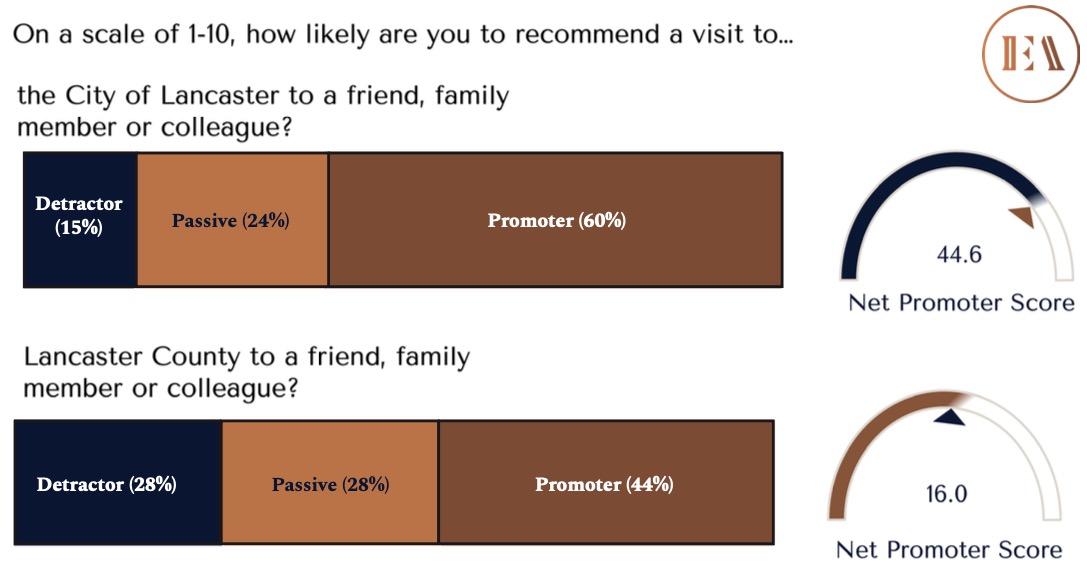
Net Promoter Scores – Recommending a visit to Lancaster City versus Lancaster County