Access to Healthy Food
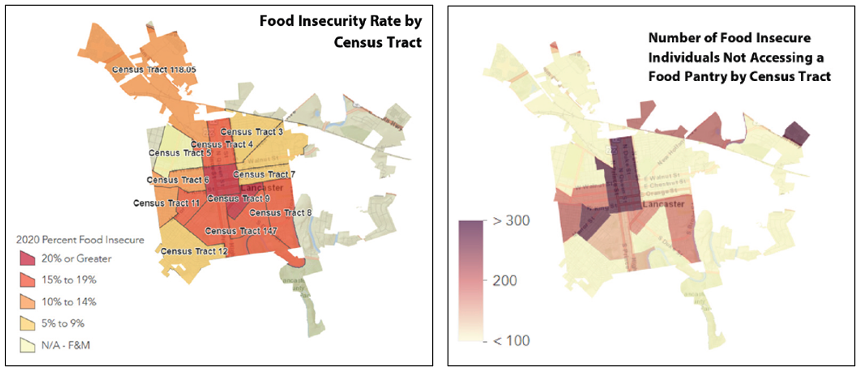
Food deserts are areas where residents have limited access to affordable, nutritious, and plentiful foods. Most Lancaster City census tracts are high or moderate food insecurity areas. In the downtown area, 20%-25% of residents may experience food insecurity. Food pantry locations are concentrated in high need areas, but additional efforts are necessary to connect residents with available resources.
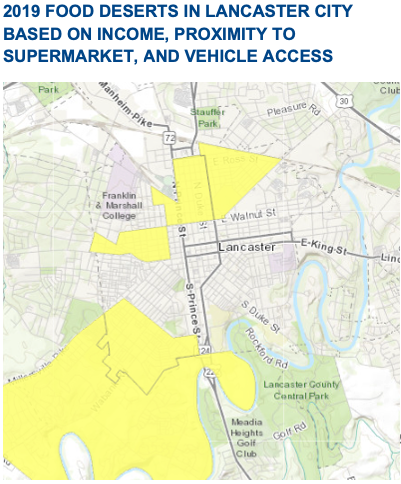
 In the northeast and southwest quadrants of the city, residents may experience socioeconomic barriers (e.g., low income, no personal vehicle) and lack access to a nearby grocery store. These areas are called food deserts, areas where residents have limited access to affordable, nutritious, and plentiful foods.
The USDA Research Atlas does not capture all food markets, such as smaller-scale grocery stores, neighborhood markets, and corner stores. While these food establishments may be more accessible to residents, they often have limited fresh, healthy food options and are typically less affordable.
The areas in yellow are considered food deserts in Lancaster City.
Housing
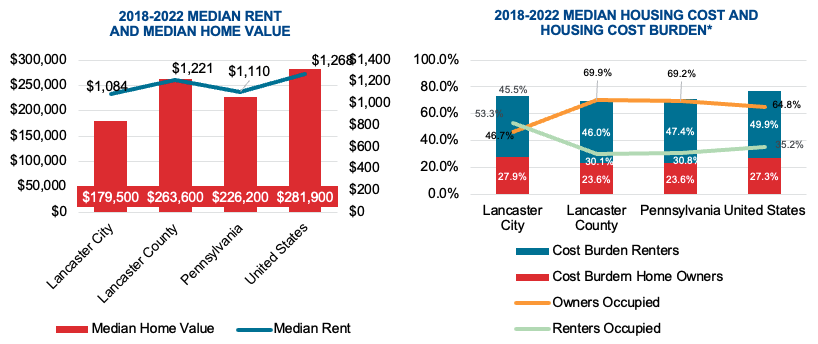
Availability of affordable, safe, quality housing was consistently identified as a top challenge for Lancaster City. Median housing costs in the city are less expensive than the county overall, but city residents experience more housing cost burden than Lancaster County residents. More than 50% of Lancaster City households rent their home and 45.5% of these households are cost-burdened by rent expenses. City homeowners are more likely to be cost burdened by mortgage expenses compared to homeowners in the county. High housing costs contribute to housing instability, and the number of people experiencing homelessness countywide increased by 33% from 2021 (394) to 2023 (526).
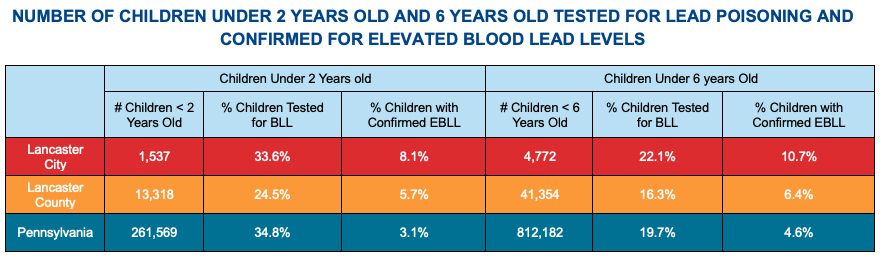
Lancaster City has significantly older housing compared to county, state, and national benchmarks. More than 70% of Lancaster City housing was built before 1960; 51% was built before 1940. In select city census tracts, more than 80% of housing was built before 1960. The burden of older housing stock in Lancaster City has contributed to more cases of lead poisoning in children. Among Lancaster City children tested in 2022, 8.1% under 2 years old and 10.7% under 6 years old had confirmed elevated blood lead levels. These proportions are the third highest among the 12 Pennsylvania cities/ municipalities with the most children under 6 years of age.
10.7% of Lancaster City children under 6 years old had confirmed elevated blood lead levels; among the highest percentages in PA.
Stakeholder Insights: Housing
Strengths
- Lancaster City is attractive to people who move from other states and older adults from other parts of the county; amenities, walkability, lower cost of living draw people to Lancaster
- Increased interest in Lancaster to developers, investors, senior living providers; home values increasing
- Long-term residential programs like the ones at Water Street Mission and YWCA are recognized as valuable to the community
Opportunities
- Market demand and higher housing costs are forcing people with lower incomes out of the city, moving them farther from supportive resources; rising concerns of neighborhood gentrification
- Limited inventory of subsidized housing and low-cost housing
- The wait time for affordable housing is years; the perception is that “There is no more Section 8 housing in Lancaster.”
- “Every new building should have affordable housing units.”
- There are strict limitations to where Section-8 vouchers can be used.
- Renters stay longer in lower cost housing units rather than “trading up”
- “There is limited upward mobility [to larger or more expensive housing].” Renters can’t afford to take on more housing costs.
- “I can’t afford to keep the job, and I can’t afford to lose it. I pay $1,500 for my apartment. I have kids and I don’t qualify for aid because of how much I make, but everything goes to pay the rent.”
- We need more support to help people transitioning out of residential or shelter programs.
- Programs are available that help residents attain and sustain homeownership, but they provide limited support to a small number of households.